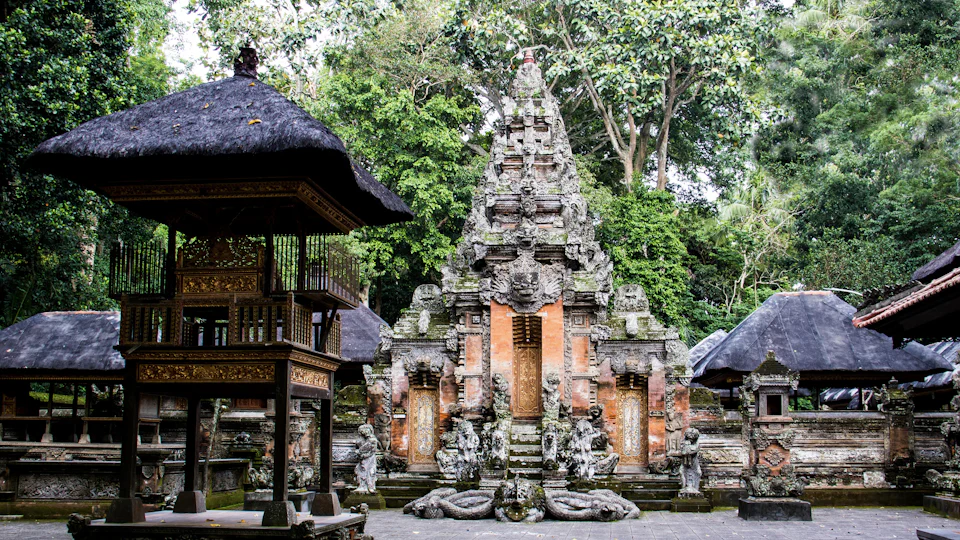
Ubud Temples, Bali: The Best Temples In and Around Ubud
Ubud, in the hills of central Bali, is ringed by temples — not monuments behind ropes, but living places where offerings are laid every morning. Some sit right in the middle of town; others are a short drive into the rice fields and river valleys. Visit them slowly and they'll teach you more about Bali than any viewpoint.
This guide covers the temples worth your time in central Ubud — all walkable — and the famous ones a short drive away that make up a classic temple day. It also covers the part most guides skip: what a Balinese temple actually is, so the courtyards stop looking like scenery and start making sense. For a ready-made route linking the out-of-town sites, see our Ubud temple day trip.
Where the Ubud temples are
Ubud's temples fall into three easy groups. Knowing which is which saves you a wasted taxi.
- In town, on foot — Pura Taman Saraswati sits on Jl. Raya Ubud in the very centre; Pura Desa Ubud is on the same main road; Pura Gunung Lebah is about 10 minutes west, down at the Campuhan river junction; Pura Dalem Agung is 15 minutes south along Monkey Forest Road, inside the forest itself.
- North, toward Tampaksiring (30–45 min) — Tirta Empul and Gunung Kawi are minutes apart at the top of this road, with Gunung Kawi Sebatu on the same run. This is the classic half-day temple drive.
- East, toward Bedulu and Pejeng (15–20 min) — Goa Gajah, the closest of the out-of-town sites, with Yeh Pulu, Pura Samuan Tiga and the Pejeng temples clustered around it.
Nothing here is far: the furthest temple in this guide is under an hour from central Ubud, and the four town temples are a single morning's walk.
| Temple | Where | Getting there | Entry | Best time |
|---|---|---|---|---|
| Pura Taman Saraswati | Central Ubud, Jl. Raya Ubud | On foot | Free | 7:00 |
| Pura Gunung Lebah | Campuhan, 10 min walk | On foot | Free | Dawn |
| Pura Desa Ubud | Central, Jl. Raya Ubud | On foot | Donation | Festival days |
| Pura Dalem Agung | Inside the Monkey Forest | On foot (forest ticket) | Forest fee | Morning |
| Tirta Empul | Tampaksiring, 30–45 min north | Drive | ~IDR 30–75k | 7:00 |
| Gunung Kawi | Tampaksiring, 30–45 min north | Drive | ~IDR 30–75k | Morning |
| Goa Gajah | Bedulu, 15–20 min east | Drive | ~IDR 30–75k | Morning |
What a Balinese temple actually is
A pura is not a building you go inside. It's a walled open-air compound, usually three courtyards deep, that steps from the everyday world toward the sacred as you move through it. The outer courtyard (jaba pisan) is a social space where preparations happen; the middle one holds pavilions for gamelan and offerings; the innermost (jeroan) holds the shrines and is often reserved for worshippers. When a gate is closed to you, that's the reason — not unfriendliness.
Two features you'll recognise everywhere once you've seen them named. The candi bentar is the split gate at the entrance: a tower cleaved down the middle, symbolising the passage from outside to in. Behind it, the meru are the tiered pagoda-like shrines, roofed in black palm fibre, whose odd number of levels — three, five, seven, up to eleven — signals which deity or ancestor is honoured there.
The reason there are so many temples around Ubud is structural, not decorative. Every traditional Balinese village maintains a set of three — the tri kahyangan — and each has a job:
- Pura Puseh, the temple of origin, honours the village's founders and its beginnings. It usually sits at the upstream, mountain-facing end.
- Pura Desa, the village temple, serves the living community and hosts its assemblies and festivals. It sits in the centre, by the crossroads.
- Pura Dalem, the temple of the dead, is associated with Shiva and with the cycle of death and release. It sits at the downstream end, near the cemetery.
So a "traditional temple" in Ubud isn't one specific site to tick off — it's this pattern, repeated in every hamlet you drive through. Once you see it, the roadside compounds you'd been ignoring turn into a map.
Temples in central Ubud
You can see these on foot, between a coffee and lunch. None takes more than half an hour unless you sit down and let it.
Pura Taman Saraswati (the Ubud Water Palace)
The one everybody photographs, and rightly. A lotus pond leads to a candi bentar draped in carving, with the shrine compound behind it. It's comparatively young — built in the 1950s to a design by I Gusti Nyoman Lempad, the great Ubud sculptor and architect — and dedicated to Saraswati, goddess of learning, music and the arts, which is why writers and musicians still leave offerings here.
Access is through the forecourt beside Café Lotus on Jl. Raya Ubud; there's no ticket gate, and you can admire the pond and gate for nothing. The stage in front hosts Balinese dance most evenings. Come at 7:00 and you'll have the ponds to yourself; come at 11:00 and you'll be queueing for the same photograph.
Pura Gunung Lebah (Campuhan)
A serene compound where two branches of the Wos river meet — campuhan means "where waters join", and confluences are considered spiritually potent in Bali. Tradition links its founding to the sage Rsi Markandeya, which would make this one of the oldest sacred sites in the area, long predating Ubud as a town.
It sits at the foot of the Campuhan Ridge Walk, about ten minutes' walk down from the main road. Pair the two: temple first at dawn, then the ridge before the heat. Of the town temples, this is the one where you're most likely to be alone.
Pura Desa Ubud
The village temple on Jl. Raya Ubud, and the plainest-looking thing in this list — which is exactly why it's worth understanding. This is the civic heart of Ubud: the temple that hosts the community's assemblies and its odalan, when the drab compound fills with penjor poles, gamelan and several hundred people in white. Walk past on an ordinary Tuesday and you'll see almost nothing. Walk past during a festival and you'll see the whole town.
Pura Dalem Agung Padangtegal
The "temple of the dead" set among banyan roots inside the Sacred Monkey Forest — a textbook pura dalem, complete with Rangda carvings at the stairways. Its inner courtyard is for worshippers, but the approach, the mossy stonework and the strangler figs are the atmospheric high point of the forest walk. You'll pass it on the forest ticket; keep your sunglasses and water bottle out of sight, and mind the macaques.
Temples a short drive out of town
These sit 20–60 minutes out, mostly north toward Tampaksiring: Tirta Empul and Gunung Kawi at the top of most lists, Goa Gajah to the east, and the quieter compounds around Bedulu and Sebatu. A driver for a half or full day is the easy way to link them, and each rewards a proper visit rather than a photo stop.
They work as a route rather than a list, so they keep their own guides instead of being repeated here: the temples near Ubud in visiting order, with rough timings and the two Pejeng temples worth adding, and Tirta Empul on its own for the purification ritual and the etiquette that goes with it.
If you only have time for two
Most people over-plan this and end up seeing five courtyards without remembering any. Two is plenty for a first visit:
- Pura Taman Saraswati at 7:00, then Pura Gunung Lebah — a walkable morning, no driver, no tickets, and the two prettiest compounds in town before anyone else is up.
- Tirta Empul, then Gunung Kawi — one drive north, two completely different registers: living ritual at the springs, then ancient stone in the valley. Half a day, back for lunch.
Combining one of each is the mistake: the northern pair needs the early light just as much as the town pair does, and you can't have both mornings at once.
Hours, fees and the practical side
- Opening hours — most temples in and around Ubud are open roughly 08:00 to 17:00 or 18:00. Taman Saraswati is effectively open through the day from the café forecourt. The Monkey Forest keeps its own hours, later than the rest.
- Entry fees — expect somewhere around IDR 30,000–75,000 per adult at the ticketed sites, usually including a sarong to borrow; the Monkey Forest is higher. Fees are revised most years, so treat any figure you read online — including this one — as a rough band rather than a price list.
- Cash — bring small notes. Card payment at temple gates is rare, and the nearest ATM is not.
- Getting there — town temples are walkable. For the northern cluster, a car with a driver for the day is the standard arrangement and costs roughly IDR 500,000–800,000, less for a half day; a scooter is cheaper and fine if you already ride confidently on Balinese roads. Ride-hailing apps work in Ubud but get patchy at the temple car parks, so agree a return with your driver rather than assuming you'll summon one.
- How long to allow — 20–30 minutes for a town temple, an hour each for Tirta Empul or Gunung Kawi, and half a day for the northern loop with driving time included.
Arrive with the light
The temples belong to two crowds: worshippers at dawn and tour buses by mid-morning. Aim for the first. Between roughly 6:30 and 8:00 the air is cool, the light is gold, and you'll often share the courtyards with families arriving to pray rather than to photograph. By 10:00 the same place can feel like a queue.
Late afternoon is the second-best window — from about 16:00 the buses thin out and the light softens again — but it's less reliable, because the wet-season rain tends to arrive in the afternoon rather than the morning. If you have one clear morning in Ubud, spend it in a temple.
What to wear
The rituals most visitors miss
Watch for canang sari: small woven trays of flowers, rice and a stick of incense, placed on shrines, steps and thresholds. They're offered fresh several times a day and then simply left to return to the earth. Don't step on them, and don't move one for a better photo.
At Tirta Empul, the purification ritual (melukat) has an order to it — pilgrims move spout to spout, skipping the last two, which are reserved for funeral rites. If you take part, follow the locals, keep quiet, and let those praying go first. Our guide to temple etiquette in Bali covers the details.
Look up, too. The tiered meru roofs are rethatched in black palm fibre by hand, and the carvings on the gates are usually a specific story rather than pattern — often the guardian Boma over the entrance, whose face is there to stop what shouldn't come in.
When the temples come alive
Bali runs on a 210-day ritual calendar, and every temple has its own anniversary, or odalan, on that cycle. On an odalan the compound you saw empty last week is full: penjor poles arching over the road, gamelan from the middle courtyard, whole families in white carrying offering towers on their heads. There's no schedule you can look up reliably from abroad — ask at your guesthouse, or simply follow the penjor when you see a street lined with them.
Two portable dates worth knowing. Galungan and Kuningan, ten days apart on the same 210-day cycle, are the biggest festivals of the year, and temples are at their busiest and most beautiful. Nyepi, the day of silence, is the opposite: for 24 hours the island stops — no flights, no traffic, nobody outdoors, temples closed to visitors. If your dates land on Nyepi, plan a hotel day and enjoy the quietest night sky you'll ever see over Bali.
Visiting during a ceremony is usually welcomed if you're dressed properly and stay at the back. It's not a performance; you're a guest at someone's church on a feast day. Ask before photographing anyone, and never step in front of a praying line for an angle.
Simple etiquette
- Never stand higher than a priest or place yourself above people who are praying.
- No flash, and never climb on shrines or gates for a shot.
- Enter and leave by the side you're directed to, and don't cross in front of someone mid-prayer.
- Menstruating women are traditionally asked not to enter temple grounds — a custom many temples still post at the gate.
Do these small things and the temples open up. You stop being a spectator and start being a quiet guest — which, on Bali, is the whole point.
Frequently Asked Questions
How many temples are there in Ubud?
More than you can count. Bali is said to hold tens of thousands of temples, and every village around Ubud has at least three — one for its origins, one for the living community, and one for the dead. For a visitor, a handful in the centre plus three or four on a day trip north makes a full, unhurried experience.
Which temples can I visit on foot in central Ubud?
Pura Taman Saraswati (the Water Palace), Pura Gunung Lebah at the foot of the Campuhan Ridge Walk, and Pura Desa Ubud on the main road are all within an easy walk of the centre. Pura Dalem Agung inside the Monkey Forest is central too, about 15 minutes south along Monkey Forest Road.
Should I stay in town or drive out to the temples?
Do both, on separate mornings. The four town temples are free or nearly so, need no driver, and are at their best before 8:00. The northern sites are a half day with a car and deserve that time rather than an hour squeezed onto the end of a walk. If you only have one morning, stay in town — see our one-day circuit of the temples near Ubud for the drive when you have a day to give it.
What is the most famous temple in Ubud?
In the town itself, Pura Taman Saraswati — the lotus-pond water palace on Jl. Raya Ubud — is the one everybody photographs. If you count the temples people drive to from Ubud, Tirta Empul at Tampaksiring is the most famous of all, and the most visited.
Is Tirta Empul in Ubud?
No — it's at Tampaksiring, about 40 minutes north of Ubud by car, and it's usually visited as a half-day trip rather than on foot. It's often described as an Ubud temple simply because Ubud is where almost everyone stays.
Is there a map of the temples in Ubud?
No single official map, but they group simply: four temples in the town centre within walking distance, a northern cluster toward Tampaksiring 30–45 minutes away (Tirta Empul, Gunung Kawi, Gunung Kawi Sebatu), and Goa Gajah with Bedulu and Pejeng 15–20 minutes east. Search each by name in your map app — the Balinese spellings above are the ones that return the right pin.
Do I have to pay to enter temples in Ubud?
Not always. Pura Taman Saraswati and Pura Gunung Lebah in town are free to admire, and the village temples ask only a donation. The ticketed sites — Tirta Empul, Gunung Kawi, Goa Gajah, the Monkey Forest — charge a modest fee, usually a few tens of thousands of rupiah, often with a sarong to borrow included. Bring cash in small notes.
What should I wear to visit a temple?
Cover your shoulders and knees, and wear the sarong and sash provided (or your own). This applies to everyone, whatever the heat.
How long do you need to see the temples in Ubud?
One morning covers the town temples comfortably on foot. Add a half day for the northern cluster and you've seen the essentials without hurrying. Two mornings, in other words — not a single packed day.
When is the best time to visit?
Early morning, ideally before 8:00, for cool air, soft light and far fewer people. The dry season — roughly April to October — is the most comfortable time of year.