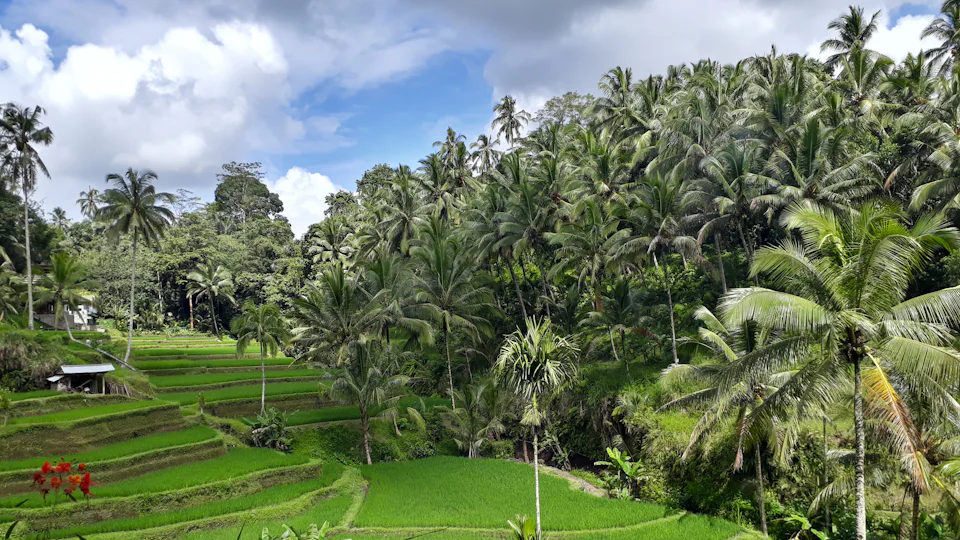
Walking the Tegallalang Rice Terraces
Tegallalang is the postcard: steep emerald steps carved into a valley north of Ubud, watered by an irrigation system Balinese farmers have shared for a thousand years. Go early and you'll understand why it became famous — and find the parts that still aren't.
The short version: the valley is open from about 7am to 6pm, entry runs 25,000 IDR, and there is no single ticket office — landowners collect small payments at several points along the walk. Arrive by 7am. The difference between 7am and 11am here is larger than at any other site near Ubud.
Beat the buses
The car park fills fast. Arrive by 7:00 and the terraces are yours: mist in the valley, farmers already working, and light raking across the steps. The same view at 11:00 comes with tour groups, drones and a wait for every photo spot. If you can only choose one thing from this guide, choose the early start.
The gates open around 7am and the valley stays walkable until about 6pm. Tour buses from the south start landing between nine and ten, which gives you a clear two-hour window if you are staying in Ubud and a much tighter one if you are driving up from the coast.
The terraces sit twenty to thirty minutes north of central Ubud on the road towards Kintamani — close enough to reach before breakfast, far enough that coming from Canggu or Seminyak means leaving in the dark.
That road is lined with coffee plantations offering free tastings, and every driver will suggest one. They are pleasant enough and they are shops; the tasting is free because the civet coffee at the end is not. Visit on the way back if you want to, never on the way there, or you will arrive to a full car park.
What it actually costs to walk in
Entry is 25,000 IDR a head. That part is simple; what confuses people is that there is no single ticket counter with a barrier, because the terraces are working farmland owned in strips by different families.
The paths across the valley run over private plots, and the family whose land you are crossing will ask for a payment at a small booth. Expect 10,000 to 20,000 IDR at each, and expect to meet two or three of them on a full loop.
This is not the scam the forums make it out to be. Those steps are somebody's rice crop, and the booths are how the paths get maintained. It does mean carrying a stack of small notes rather than one large one — nobody has change for 100,000 at half past seven in the morning.
Budget around 100,000 IDR per person for the whole morning, entry and path payments and a coffee with a view included. Current hours and fees are worth a glance before you set out, since the amounts drift upward each season.
The swings, honestly
You've seen the giant swings over the valley. They're fun, they're safe enough, and they're a business — expect a set fee per person, often bundled with a "nest" prop and a photographer.
Prices sit in a wide band depending on how elaborate the package is: a single ride at one end, the full set of props, costume and edited photos at the other. Ask what is included before you climb on rather than after.
If that's your thing, enjoy it. If it isn't, skip it entirely; the terraces themselves cost almost nothing and are the real reason you came — and every swing faces the same direction anyway.
The walk beyond the crowds
Most visitors photograph the first few terraces and leave. Don't. A path drops down the valley and up the far side — 30 to 45 minutes round trip — and within ten minutes the crowds thin to almost nothing.
You'll pass working subak channels, coconut palms and the occasional farmer who may offer to guide you for a tip. Take the offer if it's made: they know which steps hold after rain and which are for looking at.
The climb back up the far side is the part nobody photographs. It is steep, it is humid by eight, and it is why the early start matters more here than the light does — doing the same loop at eleven is a genuinely unpleasant hour.
There is a row of cafés along the top road facing the valley, and the view from a table there is the one on every postcard. Coffee costs several times what it does in Ubud, which seems fair for the seat.
- Wear shoes with grip — the steps are narrow, and slick after rain.
- Bring water; there's little shade once you're moving.
- Respect the crops. Stay on paths and don't trample young rice for a photo.
When to come
The terraces are greenest a few weeks after planting through to just before harvest. Ask locally, or simply accept that Bali's rice grows year-round in staggered plots, so some corner of the valley is always vivid green.
The subak system behind that is the reason the valley looks the way it does. Water rights are decided collectively by the farmers sharing a channel, temple by temple, and have been for something close to a thousand years — which is why the terraces step so evenly and why no single plot can take more than its share.
Season matters less than hour, though. A grey morning in the wet season with mist sitting in the valley photographs better than a hard blue noon in August, and the walk is cooler.
Frequently asked questions
How much is entry to Tegallalang?
25,000 IDR per person at the entrance, plus 10,000–20,000 IDR at each of the two or three landowner booths along the valley paths. Around 100,000 IDR covers a full morning including a drink.
What time should I arrive?
By 7am. The site opens around then, the light is raking across the steps, and the first tour buses do not arrive until nine or ten.
Do I have to pay for the swings?
Only if you want to ride one. They are run as separate businesses along the valley and are entirely optional — the terraces and the walk are the main attraction and cost a fraction of the price.
How long does the walk take?
Thirty to forty-five minutes for the loop down one side of the valley and up the other. Allow two hours if you want to stop, photograph and drink coffee at the top afterwards.
Tegallalang or Jatiluwih?
Tegallalang is the dramatic one: a narrow valley, steep steps, and the shot everybody recognises. It is also the crowded one, and it is small — the whole site is a single valley you can walk in under an hour.
Jatiluwih, out towards Batukaru, is the opposite trade. The terraces run for miles across open hillside, the crowds thin out to almost nobody, and the scale is far greater — but it is a longer drive from Ubud and it does not deliver one perfect frame the way Tegallalang does. Go to Tegallalang for the photograph and the early morning; go to Jatiluwih for the walk.
Give Tegallalang a morning rather than a photo stop, and it stops being a backdrop and becomes what it actually is: a thousand-year-old machine for turning water and patience into rice.
It slots naturally into a wider route — see the 5–7 day Bali itinerary for where it sits in a week, or when to visit Bali for the season around it.