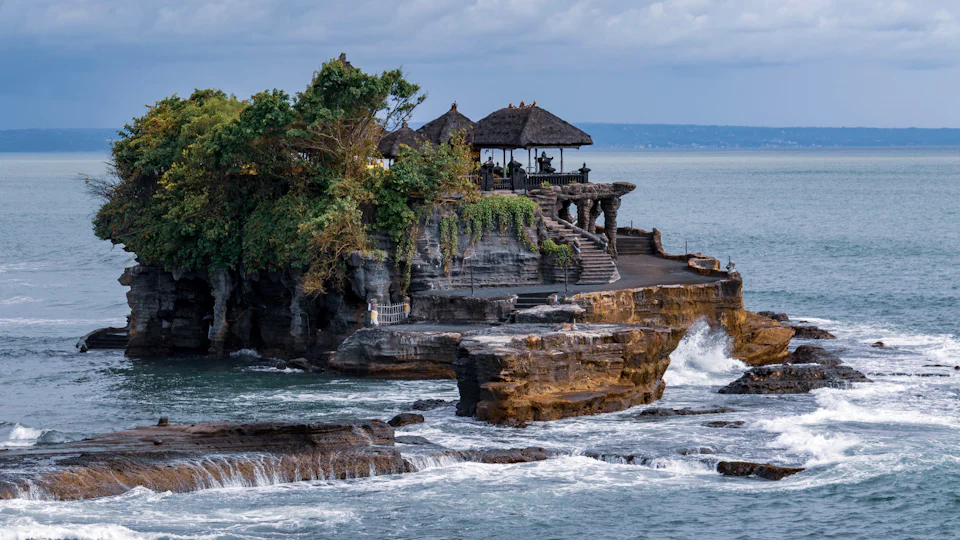
Tanah Lot: Sunset, Tides, and the Best Time to Visit
Tanah Lot is a small temple on a sea stack off Bali's west coast, and the whole visit turns on one thing most people never check: the tide. Get that right and you'll understand why it's the island's most photographed shrine.
Let the tide decide
The temple sits on a lump of basalt that the ocean long ago cut off from the shore, about 20 km west of Denpasar. Twice a day the water pulls back and twice it floods in, and that rhythm decides what you get:
- High tide wraps the rock completely — you can't reach the base, but you get the postcard: the temple apparently floating, perfect for a sunset silhouette from the clifftop terraces.
- Low tide lets you walk out to the foot of the rock, though the stones are wet, black and slick with algae, so tread carefully.
The cycle shifts by roughly an hour each day, so check a tide table for Beraban/Tabanan (not just "Bali") before you go, and note that the water comes back faster than you'd think — a half-hour of daydreaming can leave you cut off.
Come for the sunset
The sun drops behind the temple from the main viewing area, which is the whole point — that western alignment is what makes the silhouette. Sunset lands somewhere around 6:00–6:30 pm depending on the month; the golden-hour card above shows today's exact window. Arrive 60–90 minutes early to claim a spot on the terraces, because in peak months (July–August, December–January) the good vantage points are gone well before the light turns.
Crowds start building around 4pm, and closer to 3pm in peak season. If you want a terrace spot rather than a view of other people's phones, be through the gate by 4 or 4:30.
What it costs and when it opens
Entry for foreign adults is 75,000 IDR, paid at the booth by the car park. The site is open daily from 6am to 7pm, weekends and public holidays included.
Bring small notes. Card and QR payment are not accepted at the gate, and there is a separate parking charge on top — modest, but also cash.
That 75,000 buys the outer grounds, which run to about three hectares of clifftop paths, terraces and stalls. It does not buy access to the shrine itself, which is a separate matter entirely.
The island-wide tourist levy is separate again: 150,000 IDR per person, once per entry to Bali, paid online or at the airport. Nothing to do with this temple, but it catches people out at the same kind of moment.
Can you go inside?
Not into the temple itself — the shrine on the rock is reserved for Balinese worshippers, and it's the postcard-perfect silhouette from land that everyone actually comes for. At low tide you can walk across to the base of the rock, where a priest may offer a splash of holy spring water and a blessing for a small donation. In a cave at the foot of the stack live the banded sea snakes said to guard the temple; guides will point them out. Above the main temple, the clifftop shrine of Batu Bolong — perched over a natural rock arch a short walk south — is the other classic viewpoint, and often less crowded.
What you can do at low tide is walk across to the base of the rock, where a spring runs out of a cave in the basalt. A priest sits there and offers a blessing with the holy water — a few thousand rupiah in the donation box is the custom, and nobody will chase you for it.
Everything above that point is off limits. The steps up to the shrine are for worshippers, and the guards on the rock are not decorative.
Getting there
Tanah Lot is about 20 km northwest of Denpasar, near the village of Beraban in Tabanan. Reckon on 45–60 minutes by car from Canggu or Seminyak and closer to 90 minutes to two hours from Ubud or the south coast, traffic depending. Most people come with a driver for the late afternoon; there's a large paid car park and a long avenue of souvenir stalls and cafés between it and the temple. If you're routing your days, see where it fits on our Bali itinerary.
There is no public transport worth the name. Everyone arrives by hired car, scooter or driver, and the last stretch runs through a market arcade you walk before you reach the terraces — allow ten minutes on foot from the car park.
Going by driver rather than scooter is the sensible call for a sunset visit. The road back towards Canggu after dark is busy, unlit in places, and full of people who also just watched the sun go down.
A calmer visit
If you'd rather not elbow for a photo, come in the shoulder months — April to June, or September to November — when the light is just as good and the terraces aren't three deep. Wear shoes with grip for the wet rock, keep an eye on children near the water, and be politely firm with the vendors and freelance "guides" working the path. Dress as you would for any Balinese temple — see our temple etiquette guide — and stay for the blue hour after the sun's gone: the crowd thins, the temple picks up a faint glow, and the coast finally goes quiet.
The other lever is the hour. Before 10am the car park is half empty, the light is soft on the sea side, and the site reads as a temple rather than a viewing platform — the trade is that you miss the sunset the place is famous for.
Weekends and Balinese public holidays are the worst of it. Local families come in numbers, and the terraces fill from mid-afternoon in a way they simply do not on a Tuesday.
Frequently Asked Questions
What is the best time to visit Tanah Lot?
Late afternoon, ending at sunset, is the classic visit — arrive 60–90 minutes early for a terrace spot. For the view, a rising or high tide gives the "floating" silhouette; a low tide lets you walk to the base of the rock. Check a Beraban/Tabanan tide table and pair it with sunset.
Can you go inside Tanah Lot temple?
No — the shrine on the rock is reserved for Balinese worshippers. At low tide you can walk to the base of the rock and receive a blessing with holy spring water for a small donation, but visitors don't enter the temple itself.
How much is the entrance fee?
75,000 IDR for foreign adults, paid in cash at the gate, with a small extra charge for parking. Sarong rental, if you need one, is a few thousand rupiah more.
How far is Tanah Lot from Canggu or Seminyak?
Roughly 45–60 minutes by car from Canggu or Seminyak in normal traffic, and around 90 minutes to two hours from Ubud or the far south — but Bali's afternoon traffic is unpredictable, so leave a buffer to make sunset.
Is Tanah Lot worth visiting?
For sunset, yes — it's Bali's most photographed sea temple for good reason. To enjoy it, time your visit with the tide and the light, and come in a shoulder month if you can to avoid the thickest crowds.