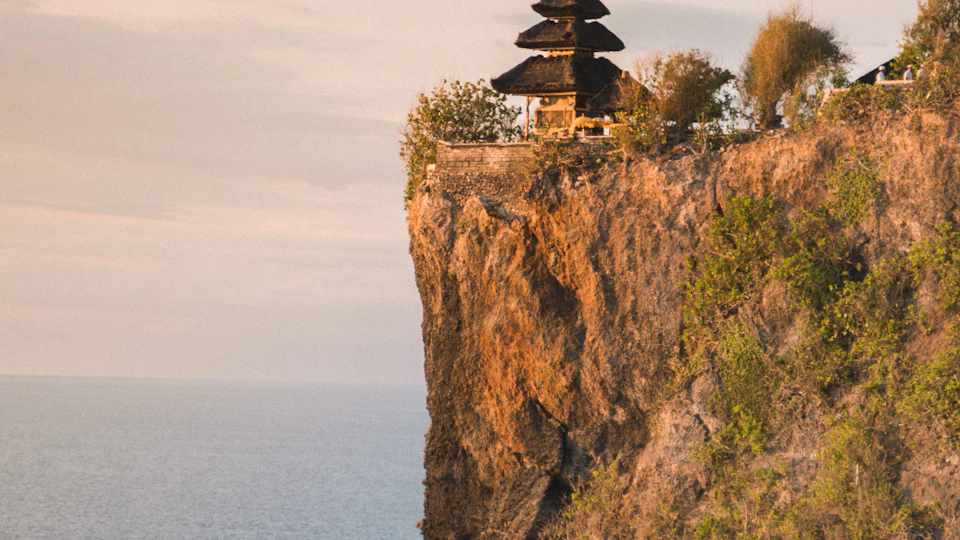
Uluwatu Temple: Sunset and the Kecak Fire Dance
Uluwatu earns its crowds honestly: a small clifftop temple seventy metres above the Indian Ocean, a sky that turns orange behind it, and a fire dance that starts just as the light goes. Time your evening well and it's the most complete few hours on the island.
Come for the sunset
Pura Luhur Uluwatu is one of Bali's six great sea temples — a guardian shrine set right on the southern cliffs of the Bukit Peninsula, where the ocean is believed to hold back the island's darker spirits. Most of the temple is closed to visitors, but the cliff path and the views are the real reason to arrive before dusk. Come about an hour ahead: the light softens, the crowds thin, and you can walk the headland while the sea turns to metal below.
The Kecak fire dance
The Kecak is younger than it looks — pieced together in the 1930s from older trance rituals — and unlike most Balinese dance it uses no gamelan at all. Instead a ring of dozens of men chant "cak-cak-cak" in overlapping rhythm, a wall of voices that carries the whole performance. The story is the Ramayana: Rama, his stolen wife Sita, the demon Ravana, and a comic troupe of monkeys. It builds to a finale with fire, the torches flaring as the last daylight drains from the sky.
The show runs daily and is timed to sunset — roughly 6:00 to 7:00 pm depending on the month — in the open-air amphitheatre on the cliff beside the temple, so the performance and the sunset land together. It lasts about an hour. Tickets are a set price, sold in cash at the gate (a separate ticket from temple entry); in the busy months they can sell out, so buying earlier in the day or online is worth it.
Getting to Uluwatu
The temple sits at the far southern tip of the Bukit Peninsula, roughly an hour from Kuta, Seminyak or the airport and a little more from Ubud, depending on Bali's unpredictable traffic. Most visitors hire a driver for the evening who waits through the dance and drives back after dark — far easier than a scooter on the winding cliff roads at night. If you go earlier, pair the temple with an afternoon at one of the Bukit's beaches — Padang Padang or Suluban are minutes away — then move up to the cliff for the sunset show.
The surf below, and what else the cliff is for
The wave breaking under the temple is one of the most famous in the world. Uluwatu's reef break was surfed into legend in the 1970s and still draws a lineup every day of the dry season, reached through a cave at the bottom of a long staircase down the cliff at Suluban. You do not need a board to make use of it: the reason to come early is that the clifftop warungs and bars look straight down onto the sets, and watching a reef break from above with a drink in hand is a genuinely different thing from watching it from the sand.
Single Fin, a few minutes from the temple, is the best known of these and fills up for sunset, particularly on Sundays. If you would rather not spend the evening in a crowd, the smaller warungs along the same clifftop have much the same view for less money and a fraction of the noise. Either way, plan the order of the evening deliberately: a cliff bar first while the light is still high, the temple and the headland walk about an hour before sunset, then the amphitheatre. Doing it the other way round means reaching the dance after the good seats have gone.
Before you go
- Arrive 45–60 minutes early. Seating in the amphitheatre is first-come, and the good rows — stage plus sea behind it — fill fast.
- Bring cash for the separate temple and dance tickets; cards aren't taken at the gates.
- Guard your things from the monkeys. Uluwatu's macaques are quick and bold — they'll take sunglasses, hats, phones and loose food. Keep everything zipped away and don't hold small items out; if one grabs something, don't chase it, and ask a staff member to help.
- Dress for the temple, with shoulders and knees covered — see our guide to temple etiquette in Bali for the details.
- Book ahead in peak season (July–August). The dance regularly sells out a few days in advance.
- Check for ceremony days. Uluwatu is an active temple, and during a piodalan anniversary or another ceremony parts of the site close to visitors and the atmosphere changes completely — worth asking your driver before you commit the evening to it.
Rain rarely stops the show — ponchos come out and the chanting carries on — but the cliff paths get slick, so wear real shoes. And don't rush off at the end: the quietest, best moment is the dark ocean after the fire has gone out and most of the crowd has drifted to the car park. If you're still mapping out your days, our Bali itinerary shows where a Uluwatu evening fits.
Frequently Asked Questions
What time is the Kecak fire dance at Uluwatu?
It's a daily performance timed to sunset — usually starting around 6:00 pm and running about an hour — in the cliff-side amphitheatre next to the temple. Exact start times shift with the season, so check locally on the day and arrive 45–60 minutes early for a good seat.
How much does Uluwatu Temple cost?
The temple charges a small entrance fee, and the Kecak dance is a separate, higher-priced ticket. Both are paid in cash at the gate, so bring rupiah; prices change, so confirm the current rate on arrival.
Can you go inside Uluwatu Temple?
The inner sanctum is reserved for worshippers, so visitors don't enter the temple itself. What you come for is open to everyone: the clifftop paths, the headland views and the sunset, plus the Kecak dance in the amphitheatre.
How long do you need at Uluwatu?
Allow two to three hours for an unhurried visit: time to walk the cliff paths before the light softens, watch the sunset, and stay for the hour-long Kecak dance.
What should I wear to Uluwatu Temple?
Cover your shoulders and knees. A sarong and sash are handed out free at the entrance if you need them, and are worn over your clothes.
How do I stop the monkeys taking my things?
Keep sunglasses, hats, phones and snacks zipped away and out of sight, and don't hold small items out. The macaques are practised thieves; if one takes something, stay calm and ask a temple staff member, who can often trade it back with fruit.
Is Uluwatu worth visiting if you don't surf?
Yes — the temple, the clifftop walk and the Kecak dance stand on their own, and most visitors never touch a board. The surf matters mainly as something to look at: the reef break below the cliff is visible from the temple headland and from the bars along it, and it is part of what makes the setting what it is. Surfers should know the break is an experienced-only reef, reached through a cave at Suluban, and not a place to learn.