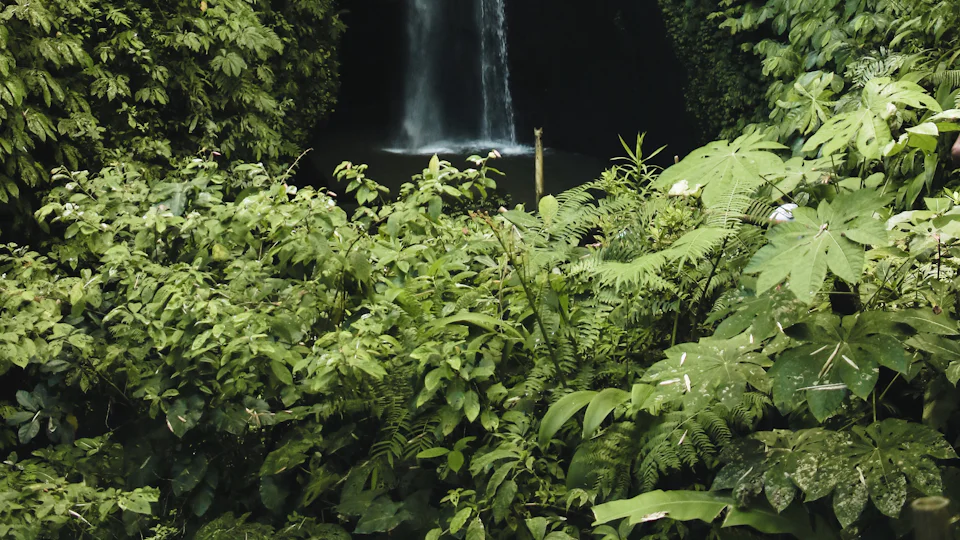
Hidden Waterfalls in Bali: Away From the Crowds
Bali's famous falls come with a queue for the photo. But a short drive off the tour route there are pools where the only sound is the water — you just have to be willing to take the rougher road and arrive early.
The short version: six falls that stay quiet if you arrive between 7 and 9am, entry between 10,000 and 50,000 IDR each, and one — Tukad Cepung — that works only between 10 and 11 because the light has to clear the canyon wall. Pick one cluster, not one from each.
The quieter falls to aim for
- Tibumana (near Bangli) — a single soft curtain into a calm green pool, reached by an easy paved path. One of the most relaxed swims on the island if you get there before the day tours.
- Tukad Cepung (near Tembuku) — a fall hidden inside a slot canyon, where a shaft of light drops through the rock mid-morning. Come early: once the canyon fills, both the beam and the space are gone.
- Leke Leke (near Tabanan) — a slender, elegant drop at the end of a quiet jungle walk over a little bamboo bridge. Rarely busy.
- Banyu Wana Amertha (near Wanagiri) — a cluster of several falls in cool highland air up by the lakes, far enough north that most day-trippers never make it.
- Nungnung — a big, thundering drop that earns its silence: it's about 500 steps down, and every one of them back up. The crowd thins with the effort.
A sixth deserves naming: Banyumala, in the hills above Lake Buyan. Two falls drop side by side into a chest-deep pool, the walk in takes about fifteen minutes on a made path, and it stays quiet because it sits far enough north that the day-trip circuit skips it. Entry is 50,000 IDR, open 8am to 6pm.
If you only manage one classic, make it Sekumpul — the island's most spectacular, and still worth it if you're first through the gate.
What each one costs
None of these are expensive; the point of listing the numbers is that you arrive with the right notes in your pocket. Prices are per person and drift upward each season.
- Nungnung — around 10,000 IDR. The cheapest entry on the island for the biggest drop, which tells you something about the 500 steps.
- Tukad Cepung — around 30,000 IDR, sometimes quoted lower off-season.
- Banyumala — 50,000 IDR, and the one where the fee most clearly maintains the path.
- Tibumana and Leke Leke — a village booth charges a modest amount at the gate; carry 20,000–50,000 a head and you will not be caught short.
Several of these sit close enough to pair. Tibumana and Tukad Cepung are both near Bangli and work as one morning; Banyumala and Banyu Wana Amertha are both in the northern highlands and make a different day entirely.
Budget for the island-wide tourist levy too, if you have not already paid it: 150,000 IDR per person, once per entry to Bali. It has nothing to do with waterfalls but lands in the same wallet.
Timing the light at Tukad Cepung
One of these falls is a timing puzzle rather than a walk. Tukad Cepung sits inside a slot canyon, and the thing people photograph is a shaft of sunlight dropping through the gap in the rock onto the water.
That beam appears roughly between 10 and 11 in the morning, when the sun is high enough to clear the canyon wall but not yet overhead. Arrive at eight and you get a dim grotto; arrive at one and you get a dim grotto again.
The tension is obvious: every other fall on this list is best at 7am, and this one is not. Do Tukad Cepung second, after an early start somewhere open, and the morning works as a pair rather than a compromise.
It also needs a dry week. A slot canyon is the worst place on the island to be during a downpour, and the light show does not happen through cloud anyway.
Planning the day around the driving
The falls are scattered, and Bali's roads punish anyone who plans by map distance. Two clusters matter: the Bangli group east of Ubud, and the northern highlands up past Bedugul.
From Ubud the Bangli falls are forty minutes to an hour; the northern ones are closer to two. From Canggu or Seminyak add an hour to both, which is why a waterfall day works far better from an Ubud base than a beach one.
A car and driver runs 650,000–900,000 IDR for a full day and is the sensible way to do it. The access roads are narrow, often wet, and end in a village car park you would rather not reverse out of on an unfamiliar scooter.
Pick one cluster and do it properly. Trying to cross from Bangli to Wanagiri in the same day means three hours in the car for two hours of walking, and you will arrive at the second fall exactly when the light has gone flat.
Our 5–7 day Bali itinerary slots a waterfall morning into a wider route, and the Sekumpul guide covers the one fall that genuinely deserves a day of its own.
How to do it right
- Go early — 7:00 to 9:00. Soft light, cool air, strong flow after overnight rain, and no one else on the path.
- Wear shoes with grip. The rock is mossy and slick; flip-flops end trips early. Long steps and short scrambles are normal.
- Bring a dry bag for phone and camera — the spray reaches further than you think.
- Skip it in heavy rain. Through the wettest months (roughly November–March) narrow canyons like Tukad Cepung can flash-flood fast; if it's been pouring, choose an open fall or another day.
- Check the flow, not just the weather. These falls are at their loudest a day or two after heavy rain and at their clearest in the dry months — you rarely get both, so decide which you came for.
- Weekdays beat weekends. Local families visit Saturday and Sunday; Tuesday to Thursday you'll often have the pool to yourself.
Respect the offerings. Several of these falls sit beside small shrines, and the woven baskets on the rocks are not decoration — step around them, and do not move one for a photograph.
Swimming is the other thing worth planning for. Tibumana and Banyumala both have pools you can properly get into; Nungnung is a wall of spray you admire from the platform rather than a swim, and Tukad Cepung is ankle-deep water on rock.
Bring a towel that dries and something to change into. There are no facilities at most of these beyond a warung and a plastic chair, and the drive back in wet clothes is longer than you think.
The trade for a rough access road and a set of muddy steps is the thing everyone actually came to Bali for: a green pool, moving water, and no one else in the frame. Take the trash back out with you, and leave it that way for whoever finds it next.